
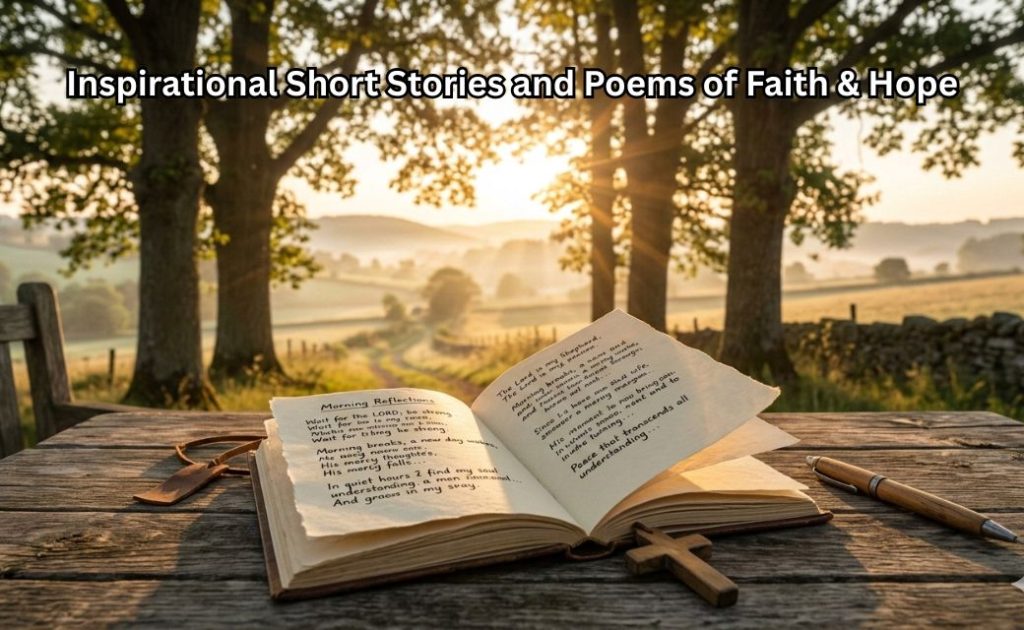
There are different seasons of life where we go through different levels of faith, at times dealing with loss and rejection, and we might even feel that heaven is blind to our sorrows. At other times, in times of chaos and confusion, we find solace in the word of God. Sometimes we see ourselves more connected to eternal truth than ever before. Faith has unique ways of helping us discover our inner voice and shapes our spiritual being. Literature, especially reflective narratives and heartfelt verse, gives shape to emotions we struggle to articulate. Through storytelling and poetry, we find mirrors of our own journeys and reminders that we are never alone in our struggles.
For all those people who are looking for reassurance and clarity, it often comes to you through faith-centered poems and short stories that lift up your morale and give you a boost. Helping you reflect upon deeper and more spiritual truths about life.
1. The Transformative Power of Short Stories:
There is something uniquely powerful about short stories. In just a few pages, a writer can capture a lifetime of emotion, a moment of revelation, or a turning point that changes everything. These compact narratives allow readers to immerse themselves quickly in relatable experiences—stories of forgiveness, redemption, perseverance, and hope.
Through faith-based storytelling, ordinary situations become extraordinary lessons. A story about a failing relationship may reveal the healing strength of grace. A tale of personal failure might illuminate the beauty of second chances. Because they are concise and focused, short stories often leave a lasting impression, encouraging readers to reflect long after the final line is only a memory.
In other contexts, these simple yet effective storytelling becomes tools for growth for different individuals who are dealing with different sorts of trouble in life. understanding that trials can carry purpose and setbacks can nurture resilience.
2. How Short Stories and Poems Capture Shared Struggles:
When short stories and poems are artistically written together, they create a rich tapestry of human experience. Stories provide structure and character-driven journeys, while poetry distills raw emotion into vivid imagery and rhythm. Together, they speak to both the mind and the heart.
Life is filled with questions: Why do we suffer? How do we forgive? Where do we find strength? Literature grounded in faith doesn’t always provide simple answers, but it offers companionship in the search. A poem about waiting on divine timing may resonate with someone navigating uncertainty. A story about unexpected blessings may inspire gratitude during difficult seasons.
The unique blend of narrative and verse takes you on a transformative journey. Where you not only understand how life changes, but most importantly, we are not alone in this journey.
3. Discovering Hope Through Inspirational Short Stories
Inspirational short stories often center on transformation. These stories reflect some of the sad truths of our reality. At times through verses and other times in prose, helping people understand deeper layers of emotions. A character who begins in despair may find hope through faith. Someone burdened by guilt may discover forgiveness. These arcs mirror real-life experiences, reminding readers that growth is possible, even when circumstances seem unchangeable.
Stories rooted in faith frequently emphasize themes such as trust, humility, gratitude, and perseverance. They show that faith is not about perfection but about persistence. Through relatable characters and authentic challenges, readers see that stumbling does not mean failing—it simply means being human.
In moments when personal belief feels fragile, these stories can serve as gentle encouragement. They remind us that even small acts of courage, choosing kindness, offering forgiveness, speaking truth, can reflect profound faith. In this way, poetry and prose books become more than entertainment; they becomes nourishment for the soul.
4. A Collection of Poems and Short Stories as a Spiritual Companion:
When you pick out some of the carefully curated collection of poems and short stories; they can act as a spiritual companion during different stages of life. Unlike longer novels that require extended time and attention, these shorter pieces allow readers to engage in meaningful reflection even during busy days.
You might read one poem in the morning and carry its message with you. You might revisit a story in the evening, discovering new meaning in its words. Over time, these readings become part of your personal spiritual rhythm.
Moreover, these faith-centered collections of poems and short stories do not always take you away from reality but ease your burden with reassurance that God is with you.
5. Short Stories of Inspiration That Reflect Everyday Faith
Faith does not only exist in grand miracles or dramatic revelations. It lives in daily choices, quiet sacrifices, and simple acts of compassion. Short stories of inspiration often highlight these subtle moments, like the mother who prays silently for her child, the friend who offers forgiveness, the individual who keeps believing despite unanswered questions.
Reading such stories encourages readers to recognize the sacred within their own routines. It reminds them that faith is not confined to formal settings or rituals. Instead, it is woven into conversations, decisions, and relationships.
6. Finding Your Own Voice Through Faith
Ultimately, the purpose of reflective literature is not only to tell stories but to awaken something within the reader. As you engage with short stories, poems, and thoughtful collections like Ghostwood – Echoes of a Living Past, you may begin to see patterns in your own life. You may recognize how past hardships strengthened your character or how moments of doubt deepened your belief.
Faith-centered storytelling reminds us that every life is a narrative still unfolding. Each person carries experiences worth sharing, lessons worth learning, and truths worth expressing. By reading about others’ journeys, we gather the courage to articulate our own.
Finding your voice through faith is not about having all the answers. It is about embracing your story with all its imperfections, its questions, its triumphs, and trusting that it holds meaning.